Bakeout completion criteria — how to decide if a bake is finished
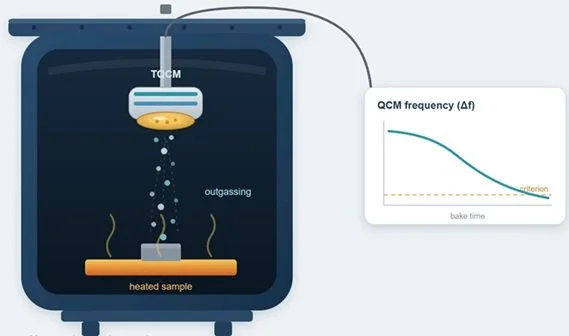
Deciding when a vacuum bakeout is complete is one of the more nuanced calls in contamination control, and we don't leave it to guesswork. Every bakeout we run is monitored with a temperature-controlled quartz crystal microbalance (QCM), so we can watch the outgassing fall away in real time and stop at a point that has been agreed with you in advance. We'll work to whichever completion criterion suits your hardware and your programme — most commonly one of the three below:
ECSS linearity criterion
We track the QCM outgassing response until it settles into a straight line — a deviation from linearity of less than 1% — subject to a minimum bake of 72 hours. A linear response means the volatile species have been driven off and only slow, stable outgassing remains. This follows the approach set out in ECSS-Q-ST-70-01C, Space product assurance – Cleanliness and contamination control, using the analysis method of ESA technical note TEC-QT/2014/344, Analysis of bake-out monitoring data.
Customer-defined duration
Where your programme or heritage specifies a fixed bake time — commonly 24 or 72 hours — we bake to that duration at the agreed temperature, with the QCM and molecular-contamination witness (MOC) plate data recorded throughout for your records. Straightforward, and often exactly what an acceptance programme calls for.
QCM rate-of-change criterion
We bake for an agreed minimum — typically 72 hours — and then continue until the rate of change of the QCM frequency falls below a pre-agreed level, for example less than 1 Hz per hour. It's an unambiguous, instrument-driven endpoint, and it mirrors the approach used by the NASA MSFC specification noted below.
Which one is right for you?
If you're working to ESA/ECSS heritage, the linearity criterion is usually the natural fit; if you're working to a fixed acceptance recipe, a defined duration is simplest; and if you want a single clear rate threshold, the QCM rate criterion does the job. If you're not sure, tell us about your hardware and mission and we'll help you settle on a defensible criterion — and, whichever we use, you get the full monitored record to back it up.
Other bakeout standards
Your programme may call up one of these agency specifications. We can bake and report against them:
MSFC-SPEC-1238, Thermal Vacuum Bakeout Specification for Contamination Sensitive Hardware — NASA Marshall's bakeout specification for contamination-sensitive hardware. It defines completion by a temperature-controlled QCM deposition rate that levels out to 1 Hz/hour or less, held on average over 36 hours, then confirmed by exposing an optical witness sample.
GSFC-STD-7000B, General Environmental Verification Standard (GEVS) for GSFC Flight Programs and Projects — NASA Goddard's broad environmental verification standard. It requires vacuum bakeout as part of contamination control but sets no numeric stopping criterion of its own, leaving the specific endpoint to the project's contamination control plan.
Common questions
What bakeout completion criteria does TS-Space offer? Three, most commonly: an ECSS linearity criterion (deviation from linearity under 1%, minimum 72 hours), a customer-defined bake duration (e.g. 24 or 72 hours), or a QCM rate-of-change criterion (e.g. under 1 Hz/hour after a 72-hour bake). Every bake is QCM-monitored throughout.
What is the MSFC-SPEC-1238 bakeout criterion? Completion is reached when the temperature-controlled QCM deposition rate levels out to 1 Hz/hour or less, maintained on average over 36 hours, then confirmed with an optical witness sample.
Does GSFC-STD-7000B (GEVS) specify when to stop a bakeout? No. GEVS requires contamination to be controlled and verified but leaves the specific bakeout stopping criterion to the project's contamination control plan.