Offgassing testing
Offgassing testing measures the gas load a material or component releases under vacuum — how much gas it gives off, as a quantified rate. That figure matters because a material's offgassing rate directly governs pump-down time, the ultimate pressure a system can reach, and the gas load imposed on sensitive instruments and vacuum hardware. TS-Space Systems provides quantitative offgassing testing in the UK, reporting a specific gas-load rate with a stated uncertainty — a defensible figure you can design against.
Offgassing versus outgassing — which test is this?
It's worth being clear, because the two are often confused:
Offgassing testing (this service) answers how much gas a material releases into a vacuum. We report it as a specific gas-load rate, normalised to sample area, in units of mbar·L·s⁻¹·cm⁻². It's a vacuum-engineering quantity: it tells you what the material will do to your pump-down and base pressure.
Outgassing testing answers what condensable material comes off and whether it will contaminate — the TML/CVCM screen. That's a separate test, covered on our Outgassing testing (TML/CVCM) page.
If you're unsure which you need, the Outgassing vs Offgassing blog post gives more information on the distinction.
How we measure the offgassing rate
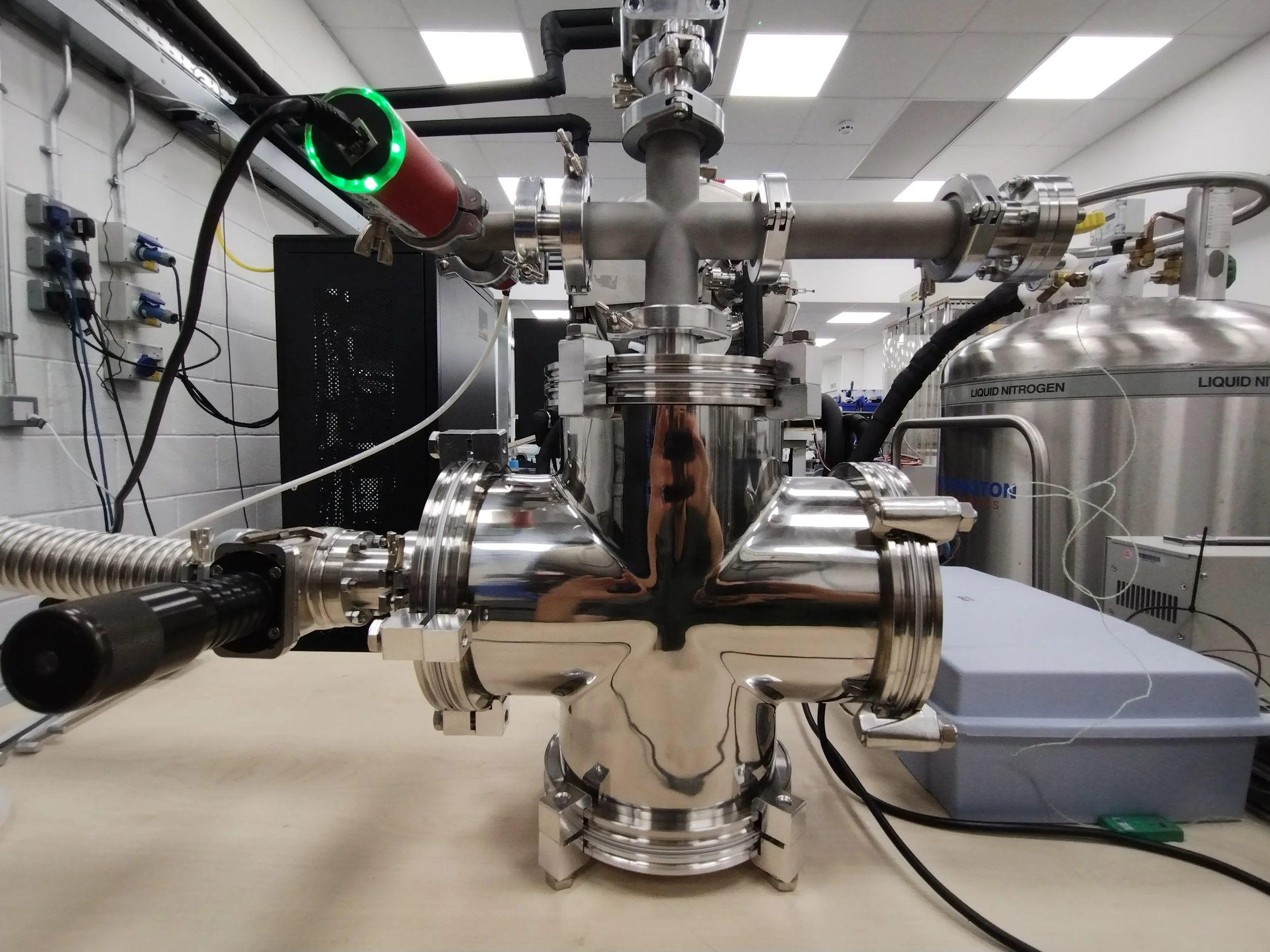
We use an accumulated-gas (rate-of-rise) technique, which gives a direct, traceable measurement of gas load. The specimen is held at a controlled temperature on a temperature-controlled block, and the system is pumped down and allowed to stabilise.
The pump is then isolated from the chamber and the pressure rise is recorded — the rate of that rise is the gas being released.
We take the steepest tangential slope of the pressure curve
Crucially, we run the same measurement on the empty chamber (a blank) and subtract it, so the chamber-wall background is removed and only the sample's contribution remains.
Each measurement is the average of runs and the test can be tailored to your specific requirements if needed.
RGA can be run in parallel for speciation of the offgassing.
Bakeout and contamination characterisation
Offgassing testing is often run after a monitored vacuum bakeout, so you learn both how much a material gives off and how effectively a bake reduces it. In that combined workflow we run a 24-hour monitored TVAC bakeout with a quartz crystal monitor (QCM) tracking mass deposition and molecular-contamination witness (MOC) plates analysed in-house by FTIR to ECSS-Q-ST-70-05C — so contamination is characterised alongside the gas-load figure. See Vacuum bakeout testing for more information on this stage.
Why use TS-Space for your offgassing testing?
ESA approved as a ‘Trusted Laboratory -Having taken part in the ESA 2018-2019 inter laboratory activity in 2018-2019 we are approved by ESA for conducting the ECSS-Q-ST-70-02C standard outgassing test.
We build our own rigs -We designed, manufactured and operate our outgassing test facility ourselves so we know the system inside out. From the hardware to the the control and analysis software, so the method is transparent and adaptable to your material.
Extensive experience with sample preparation - Our outgassing facility has been running for decades and we have seen all sorts of sample types. We are happy to advise on best practices for difficult materials so that your test produces meaningful results.
Pair it with speciation— where you need to know what is coming off, not just how much, we add residual-gas analysis (RGA); the rate-of-rise gives total gas load, RGA gives the species.
Easy to work with -With decades of experience we understand that testing can be stressful enough as it is. We don’t load you with onerous forms and paperwork, we just want to help you get the job done and on time.
““Oxford Space Systems has used TS-Space’s services since 2015. Their consistent efficiency, clear communication, and flexibility to accommodate our deployable antenna project timelines makes them the ‘go-to’ test facility for OSS’s outgassing test needs. Based on their excellent service, I would be happy to recommend TS-Space to any organisation seeking a dependable test facility.””
