Outgassing Testing
ECSS-Q-ST-70-02C & ASTM E595
Materials used in vacuum release volatile species that can condense on colder surfaces — degrading optics, detectors, thermal-control coatings and mechanisms. Outgassing testing screens and characterises those materials before they reach a sensitive instrument or spacecraft. TS-Space Systems provides ESA approved outgassing testing and molecular-contamination analysis in the UK, backed by decades of vacuum testing experience and an in-house FTIR facility for identifying the species that actually come off your materials.
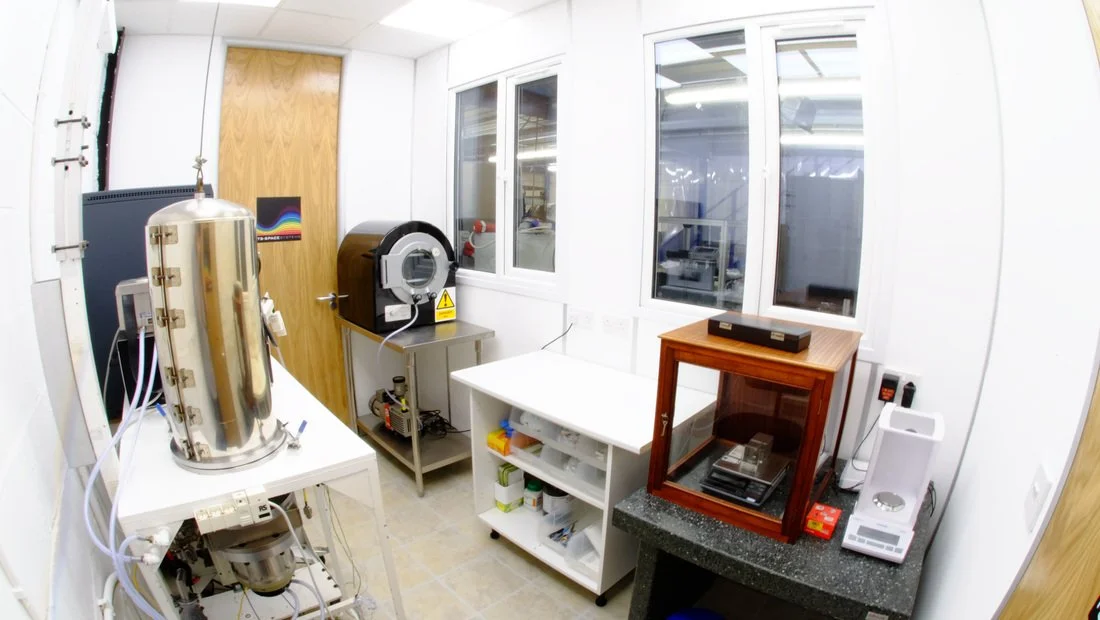
Our outgassing facility is built to NASA and ESA specifications and has been approved by ESA as a trusted laboratory for ECSS-Q-ST-70-02C outgassing activities.
Tests are run to ECSS-Q-ST-70-02C 2008 issue (previously ECSS-Q-70-02A, generic ECSS-Q-70-02).
Twelve cells (two blocks of six) are available per run.
A report of mass loss and gain is produced with annotations where anomalies or unexpected results arise.
Oil-free high-vacuum chambers (magnetically levitated turbo, dry scroll backing) — no pump-oil artefacts in your data.
In-house FTIR for CVCM species identification
Residual Gas Analysis (RGA) on request
Please note: your material or product have already been tested/approved. It is worth checking the SPACEMATDB database which searches across multiple outgassing databases.
What outgassing testing measures
Total mass loss (TML) — the percentage of a specimen's initial mass lost after a defined exposure to vacuum and temperature. It captures everything that leaves the material.
Collected volatile condensable material (CVCM) — the percentage of the specimen's initial mass that condenses on a cooled collector during the test. This is the fraction that poses the possible contamination threat to nearby cold surfaces.
Water vapour regained (WVR) — an optional third figure, the mass a specimen re-absorbs after reconditioning, distinguishing water from other volatiles.
Identifying with in-house FTIR
Screening tells you how much condenses; identifying what it is tells you where the problem comes from. We process collector plates in-house by Fourier-transform infrared spectroscopy (FTIR) so condensed species can be identified rather than guessed at. Having this capability on site means faster turnaround and a data-driven answer, not an assumption.
Why use TS-Space for your outgassing testing?
ESA approved as a ‘Trusted Laboratory - Having taken part in the ESA 2018-2019 inter laboratory activity in 2018-2019 we are approved by ESA for conducting the ECSS-Q-ST-70-02C standard outgassing test.
We build our own rigs -We designed, manufactured and operate our outgassing test facility ourselves so we know the system inside out.
Extensive experience with sample preparation - Our outgassing facility has been running for decades and we have seen all sorts of sample types. We are happy to advise on best practices for difficult materials so that your test produces meaningful results.
We identify, not just quantify — Our in-house FTIR means condensed species can be profiled using data rather than assumption.
Easy to work with - With decades of experience we understand that testing can be stressful enough as it is. We don’t load you with onerous forms and paperwork, we just want to help you get the job done and on time.
““Oxford Space Systems has used TS-Space’s services since 2015. Their consistent efficiency, clear communication, and flexibility to accommodate our deployable antenna project timelines makes them the ‘go-to’ test facility for OSS’s outgassing test needs. Based on their excellent service, I would be happy to recommend TS-Space to any organisation seeking a dependable test facility.””
