Thermal vacuum (TVAC) testing
Thermal vacuum testing subjects your hardware to the two conditions that define space at once — high vacuum and repeated temperature extremes — so that outgassing, thermal-expansion mismatches, workmanship faults and functional failures surface on the ground rather than in orbit. At TS-Space Systems we have run thermal vacuum (TVAC) testing for space flight hardware, instruments and materials for over 30 years, and because we design, build and operate our own chambers in-house, we can adapt a test to your hardware far more readily than most test houses.
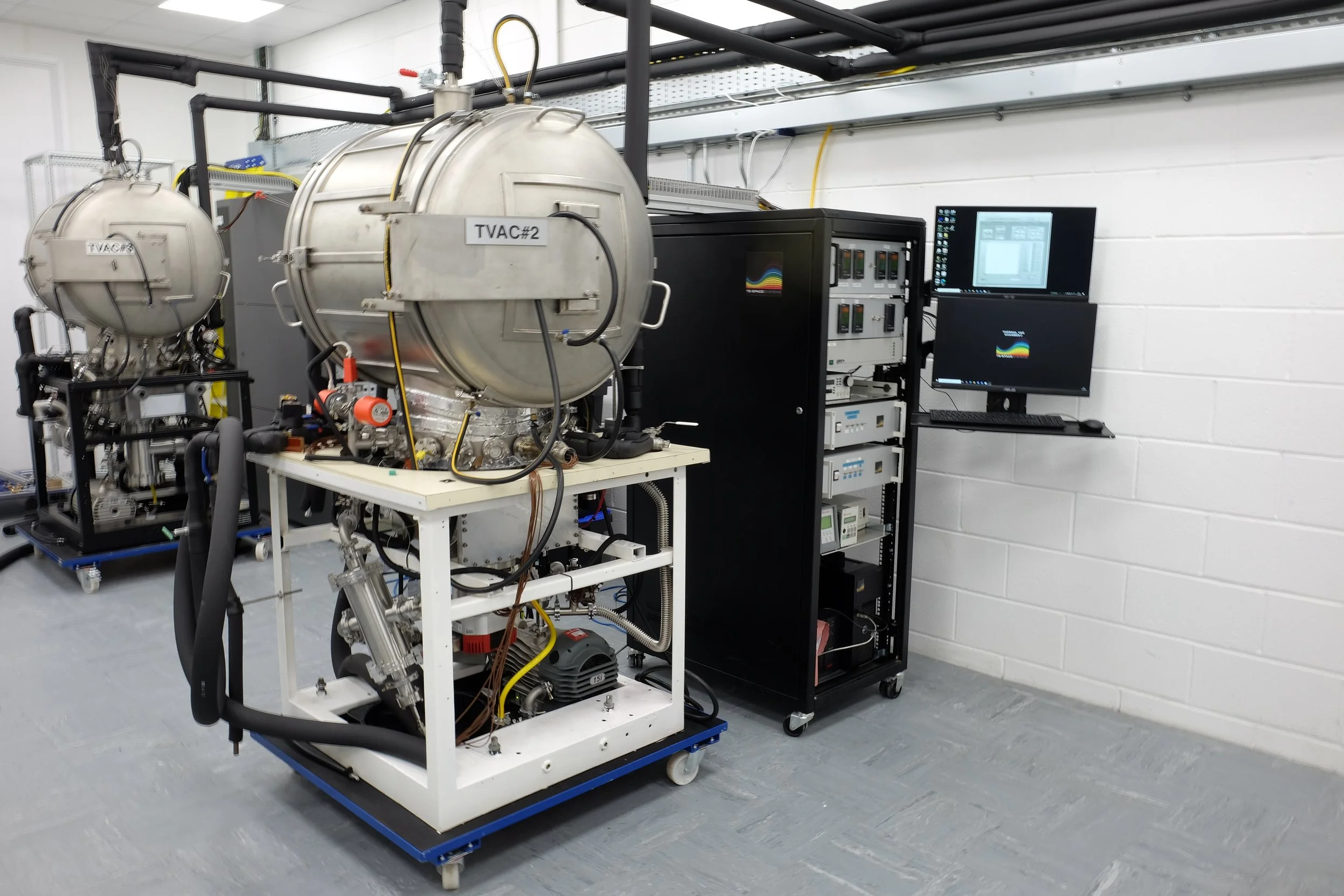
We offer thermal vacuum cycling and monitored dwell testing across three in-house TVAC chambers located in our ISO-8 class clean room, all configurable for a wide range of thermal profiles and sample sizes. A typical thermal vacuum test with us includes:
Pump-down to high vacuum using a completely oil-free system (magnetically levitated turbomolecular pump backed by a dry scroll pump), so there is no risk of hydrocarbon back-migration onto your hardware.
Thermal cycling between defined hot and cold plateaux, with programmable ramp rates and dwell times to your specification.
Continuous digital logging of temperature, pressure and — where required — TCQCM and residual gas analyser (RGA) data.
Test-point holds, over-temperature protection and remote monitoring, so long or overnight cycles run safely and without interruption.
We routinely support testing referencing the ESA ECSS series, including ECSS-Q-ST-70-04C (thermal vacuum cycling) and ECSS-Q-ST-70-01 (monitored vacuum bakeout) and are happy to use our 30-plus years of experience to advise you on any test requirements.
Chamber capability
Multiple TVAC systems: TVAC#1, #2 and #3
Temperature range: up to +300 °C and down to approximately −200 °C (nominal LN2 temperature, dependent on the thermal load of the sample).
Thermal control: PID-controlled thermal plates and shrouds with resistive heating and liquid cooling by chiller circulator or LN2.
Instrumentation: [13] T-type thermocouple channels as standard, with 16 additional channels or other thermocouple types available on request; temperature, pressure, QCM and RGA logged digitally.
Cleanliness: chambers sit within a HEPA-filtered air room, so flight hardware and contamination-sensitive samples can be loaded in a controlled environment.
Chamber sizes / usable volumes: Maximum volume. Specimen length [mm]: 450.0 | Specimen width/dia [mm]: 540.0 | Specimen height/thk [mm]: 350.0
Nominal vacuum limit [Torr]: 1E-7
Why use TS-Space for your thermal vacuum testing?
We build our own rigs - Because we design, manufacture and operate the chambers ourselves, we can modify feedthroughs, make additional support equipment and adapt the way a chamber runs to suit your hardware — flexibility most third-party test houses can't offer.
ISO Class 8 clean room - Our TVAC chambers are located in an ISO Class 8 clean room for the loading/unloading of hardware during your test.
Oil-free pumping systems - Magnetically levitated turbo and dry scroll pumping means a clean vacuum with no pump-oil contamination pathway.
Contamination monitoring on hand - A cold plate and temperature-controlled QCM are fitted for in-situ contamination monitoring, and our in-house FTIR facility can identify condensed species on witness plates to ECSS-Q-ST-70-05C.
Full control - From HEPA-filtered loading areas, to facility UPS, automatic over/under-temperature shutdown and full remote monitoring we are set to protect valuable hardware during testing.
Easy to work with -With decades of experience we understand that testing can be stressful enough as it is. We don’t load you with onerous forms and paperwork, we just want to help you get the job done and on time.
“TS Space Sytems is a very competent and professional company. They always provided us with results and advised us on the best technical solutions to achieve our testing needs. They always looked forward to improve and develop processes to meet our stringent requirements.”
