Combined Vacuum + Ambient Pressure Thermal Cycling
Not every thermal-cycling campaign needs every cycle run under vacuum. Where the test requirement allows, TS-Space Systems can run the required vacuum cycles first and then, without removing your hardware, isolate the chamber before backfilling it with a clean inert gas then completing the remaining cycles at ambient pressure, all in the same chamber. It's a faster, lower-cost route to the same cycle count with less handling and contamination risk. We introduced this hybrid capability in direct response to customer requests.
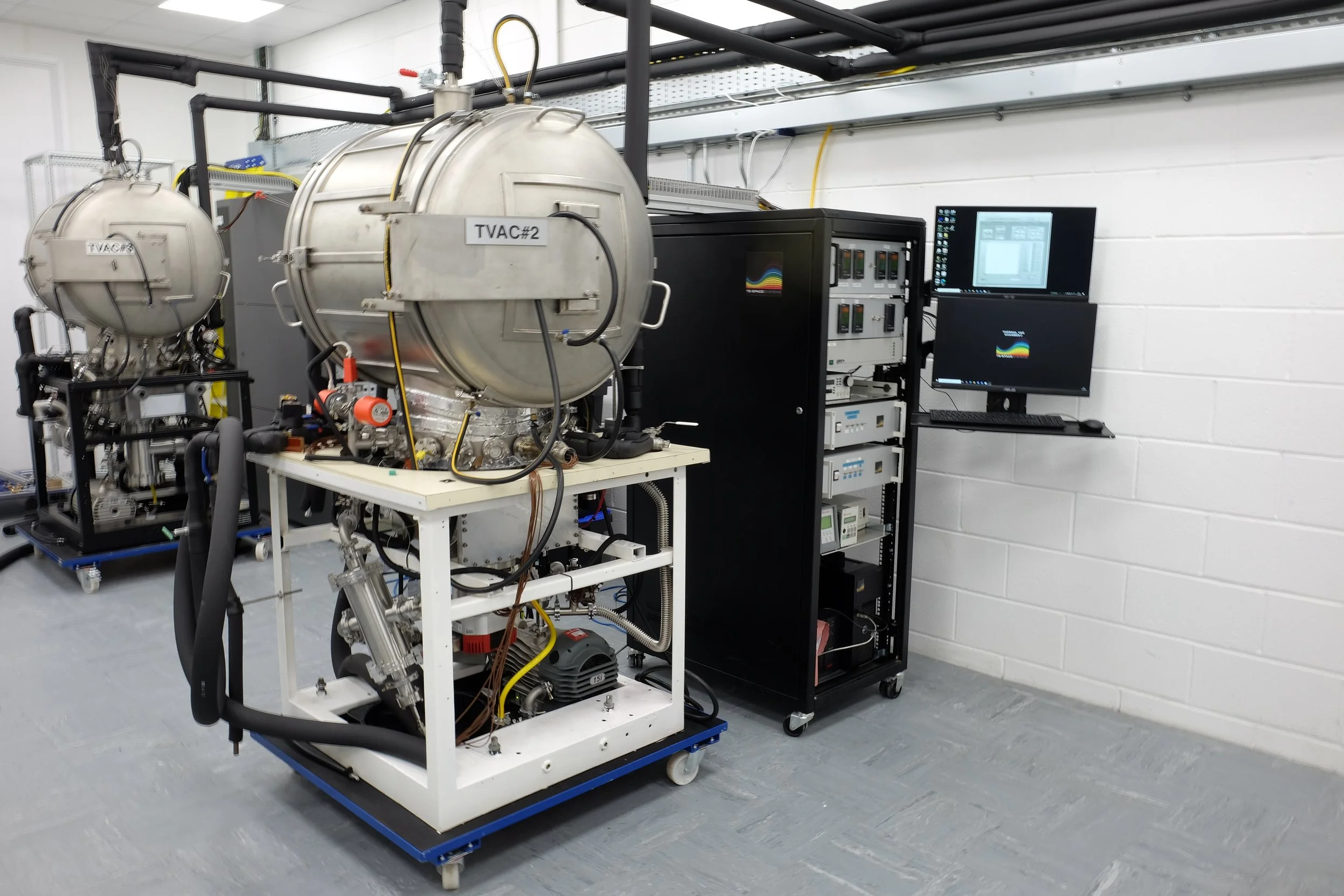
The hardware stays in one chamber for the whole test. A typical sequence is:
Vacuum phase — the chamber is pumped down and the agreed number of thermal cycles is run as a standard thermal-vacuum (TVAC) test, optionally preceded by a monitored vacuum bakeout.
Transition — the chamber is isolated from the pumping system, the ambient pressure control circuits are switched in and the chamber is backfilled with a clean, inert gas (we use Argon) up to ambient pressure. Your hardware never leaves the chamber.
Ambient phase — the remaining thermal cycles are run at ambient pressure in the inert atmosphere. Because gas convection improves heat transfer, these cycles are generally quicker than their vacuum equivalents.
Temperature and pressure are logged throughout, with QCM, RGA and witness-plate contamination monitoring available for the vacuum pressure cycles if your programme needs it (this will require opening the chamber between vacuum/ambient transition to retrieve MOC plates)
Why run combined vacuum + ambient pressure thermal cycling?
One chamber, no transfer. The hardware stays put for the entire campaign. There's no breaking of the test configuration and no moving the article between a vacuum facility and a separate ambient-cycling chamber — which removes a whole class of schedule risk and handling damage.
Cleaner and drier. If a vacuum bakeout has been run first, keeping the hardware under vacuum and then under inert gas avoids re-uptake of atmospheric water, and sidesteps the contamination and handling exposure of removing and transporting the article between a vacuum stage and an ambient stage.
Faster and more cost-effective. Ambient-pressure cycling is quicker than running every cycle under vacuum, thanks to better convective heat transfer. Where the requirement allows cycles to be split, that shortens the schedule and reduces cost without changing the cycle count achieved.
Why use TS-Space for your thermal vacuum and ambient pressure testing?
We build our own rigs - Because we design, manufacture and operate the chambers ourselves, we can modify feedthroughs, make additional support equipment and adapt the way a chamber runs to suit your hardware — flexibility most third-party test houses can't offer.
ISO Class 8 clean room - Our TVAC chambers are located in an ISO Class 8 clean room for the loading/unloading of hardware during your test.
Oil-free pumping systems - Magnetically levitated turbo and dry scroll pumping means a clean vacuum with no pump-oil contamination pathway.
Contamination monitoring on hand - A cold plate and temperature-controlled QCM are fitted for in-situ contamination monitoring, and our in-house FTIR facility can identify condensed species on witness plates to ECSS-Q-ST-70-05C.
Full control - From HEPA-filtered loading areas, to facility UPS, automatic over/under-temperature shutdown and full remote monitoring we are set to protect valuable hardware during testing.
Easy to work with -With decades of experience we understand that testing can be stressful enough as it is. We don’t load you with onerous forms and paperwork, we just want to help you get the job done and on time.
Standards we work to
Thermal cycling of space hardware is governed by a family of European and US standards, and the combined (or "hybrid") approach of accruing part of the required cycles under vacuum and the remainder at ambient pressure is accommodated across them, where the applicable specification and mission profile allow. We routinely work to:
ECSS-E-ST-10-03C — Space engineering – Testing. The European standard for environmental testing of space hardware, covering thermal cycling under both vacuum and non-vacuum conditions.
ECSS-Q-ST-70-04C — Space product assurance – Thermal testing for the evaluation of space materials, processes, mechanical parts and assemblies. The European standard for thermal-vacuum cycling of materials and assemblies.
SMC-S-016 — Test Requirements for Space Vehicles, with its heritage standard MIL-STD-1540. The US standards under which the required thermal cycles can be met through a combination of thermal-vacuum and ambient thermal cycles.
GSFC-STD-7000B (GEVS) — General Environmental Verification Standard for GSFC Flight Programs and Projects. NASA Goddard's environmental verification standard, addressing both thermal-vacuum and ambient thermal cycling.
“TS Space Sytems is a very competent and professional company. They always provided us with results and advised us on the best technical solutions to achieve our testing needs. They always looked forward to improve and develop processes to meet our stringent requirements.”
